How Much Does a Domain Really Cost? What to Watch Before You Buy
A domain's price can look great at checkout, but the real cost often only shows up at renewal. Here's what to look at before choosing a domain for your business.
 Written byGrzegorz Kaczmarek — Founder, GKD Agency
Jump to section
A web domain is one of the first purchases when building a company website. At first glance it seems simple: you type a name, you see a price, you buy.
The problem starts when the first-year price looks great but the renewal price is already several times higher.
In practice, a domain for a small business usually shouldn't be the biggest cost of the whole project. For a standard name you can normally find a reasonable option costing anywhere from a few dozen to a few hundred złoty per year, depending on the extension and the seller. But you need to know what to look at before buying.
#The key point: look at the renewal price, not just the purchase price
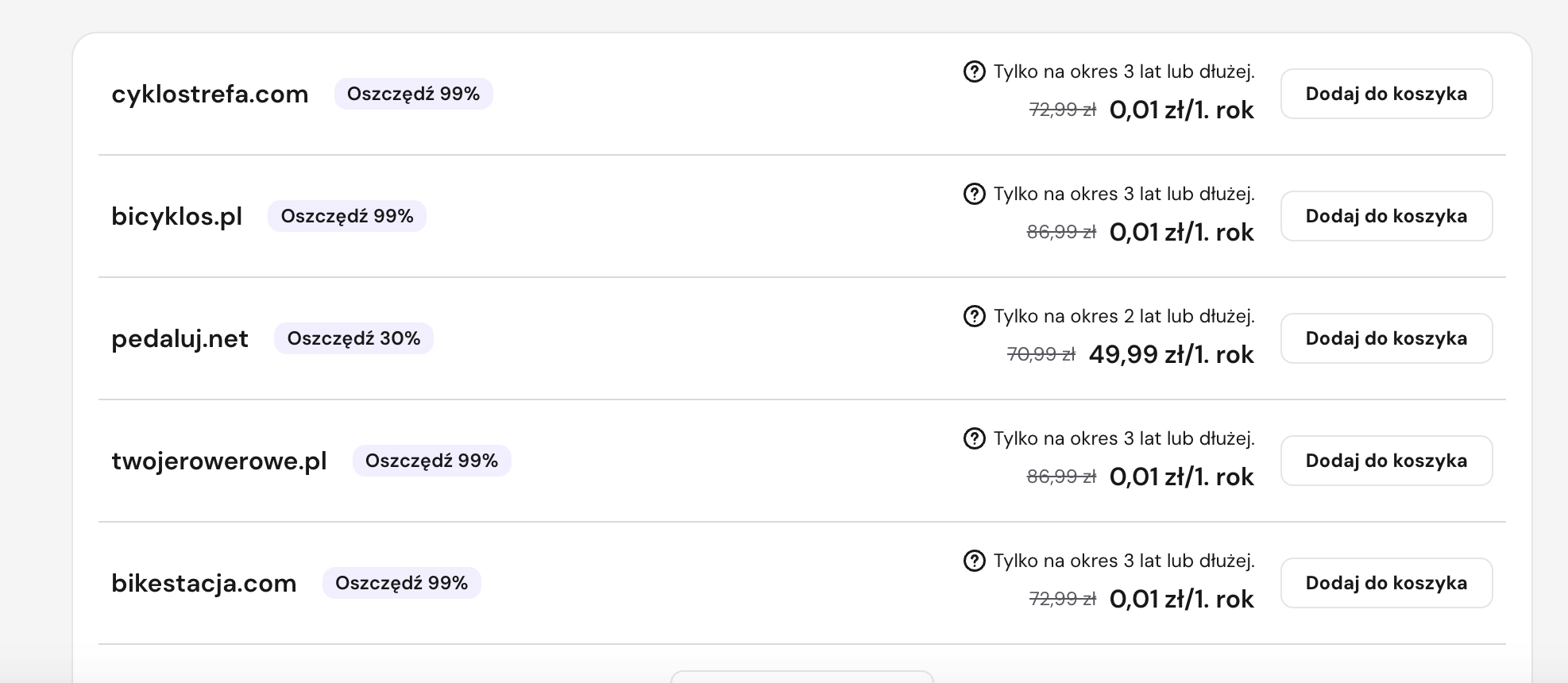
Domain sellers often show a very attractive price for the first year. You might see a domain for a few złoty, a dozen or so złoty, or even symbolic pennies.
That doesn't mean it will cost that much every year.
For example, in the domain cart you might see:
- first-year price: 19,99 zł,
- renewal price: 86,99 zł/year.
That can still be a fair offer, but only if you consciously see both costs. The worst situation is buying a domain just because "it's cheap right now," without checking how much it will cost in a year.
A domain is not a one-time purchase. It's more like a subscription to a name that has to be renewed.
#How much can a domain realistically cost?
For a typical company website it's usually wise to assume the domain will cost from a few dozen to roughly 100–150 zł per year. Sometimes less, sometimes more, depending on the extension, the seller, and current promotions.
For example:
| Domain type | What to expect |
|---|---|
.pl | a good choice for companies operating mainly in Poland |
.com | a good choice for a commercial or international brand |
.dev | suits technology and developer projects |
.io | often used by startups and SaaS tools |
.ai | popular for products related to artificial intelligence |
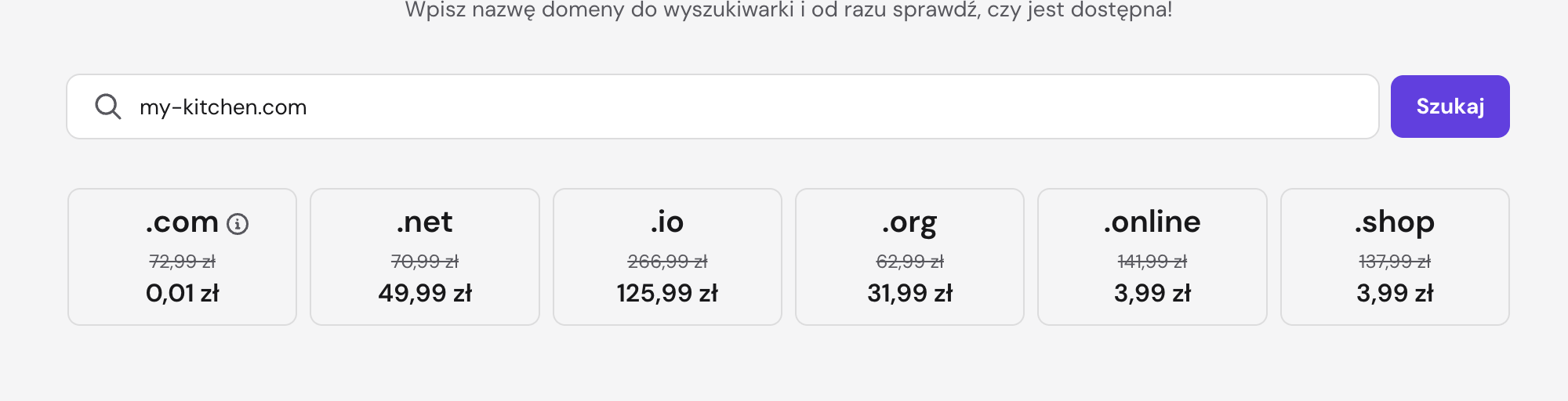
The cheapest domain won't always be the best. For a company website, the domain affects not only cost but also trust.
#A cheap extension can look less credible
Some domain extensions are very cheap, but for that reason they tend to be used more often for spam, phishing, or low-quality sites. That doesn't mean every site on such a domain is bad. It only means you have to be careful, especially if the site is meant to build customer trust.
For a company operating in Poland, the safe choice will most often be .pl.
For a company that wants to look more global, .com can be a good choice.
For strictly technology projects, extensions such as .dev, .io, or .ai can also make sense, but only when they fit the brand and the audience.
If you run a local service business, it's usually better to have a simple .pl domain than a strange, cheap extension that looks random.
#Why are some domains much more expensive?
A domain's price goes up when the name is especially attractive.
Domains can be more expensive when they are:
- very short,
- easy to remember,
- generic, for example tied to a popular industry,
- similar to a well-known brand,
- listed as premium domains by the current owner or the registry.
Example: an ordinary, longer name for a small business might cost a few dozen złoty per year. But a short domain with a popular word might cost hundreds, thousands, or much more.
That's why, when choosing a company or product name, it's worth checking domain availability right away. Sometimes a minimal change to the name lets you avoid very high costs.
#The domain seller also matters
You can buy a domain from different types of companies.
There are companies that focus mainly on domains. There are also hosting companies that sell domains as an add-on to hosting. And there are infrastructure providers where the domain is just one of many elements of a technical ecosystem.
Each model has pros and cons.
A hosting company can be convenient if you want your domain, hosting, and email in one place. An infrastructure provider can be good if you care about technical control, DNS, security, and integrations. A registrar focused on domains may have a wide choice of extensions and promotions.
The most important question, however, is not "where is it cheapest today?" but:
how much will I pay to renew in a year, and how easy will it be to move the domain if I change my mind?
#Can you buy a domain cheaply and then move it?
Yes, a domain can usually be transferred to another provider. It's a bit like switching phone carriers: you're not tied to one provider for life.
That doesn't mean it's always worth buying a domain in the cheapest promotion and immediately planning a transfer.
A domain transfer can be simple, but it requires attention. You have to take care of correct DNS settings, transfer codes, renewal deadlines, and panel access. With a configuration mistake, it can happen that the site or email stop working for a while.
That's why, if a domain is important for the business, I wouldn't leave the transfer to the last day before expiry.
#What to check before buying a domain?
Before buying a domain, it's worth checking:
- the registration price for the first year,
- the renewal price after the first year,
- the price for registering for 2 or 3 years,
- the cost of transferring to another provider,
- whether you have access to the full DNS configuration,
- whether the domain looks good in an email and on a business card,
- whether the extension fits the market and the industry,
- whether the name is not too similar to an existing brand.
For a company website, the domain should be easy to dictate, easy to remember, and as natural as possible for the customer.
#My practical rule
If the domain is for a small business, a service website, or a portfolio, I wouldn't chase savings at all costs.
The difference between a domain at 30 zł and a domain at 90 zł per year is small compared to the cost of building the site, technical maintenance, marketing, or lost customer trust.
It's worth saving, but not at the expense of credibility.
For a Polish company I would most often start by checking the .pl domain. If the brand is meant to be international, I would also check .com. Only later would I consider more specialized extensions such as .dev, .io, or .ai.
#Summary
A domain usually doesn't have to be expensive, but its price can be misleading.
Don't look only at the first-year promotion. Check the renewal price, the reputation of the extension, and the option to move the domain to another provider.
A good domain for a business should be simple, credible, and predictable in cost. Sometimes it's better to pay a little more with a trusted seller than to save a few dozen złoty and later lose time on transfers, configuration, or site availability problems.